
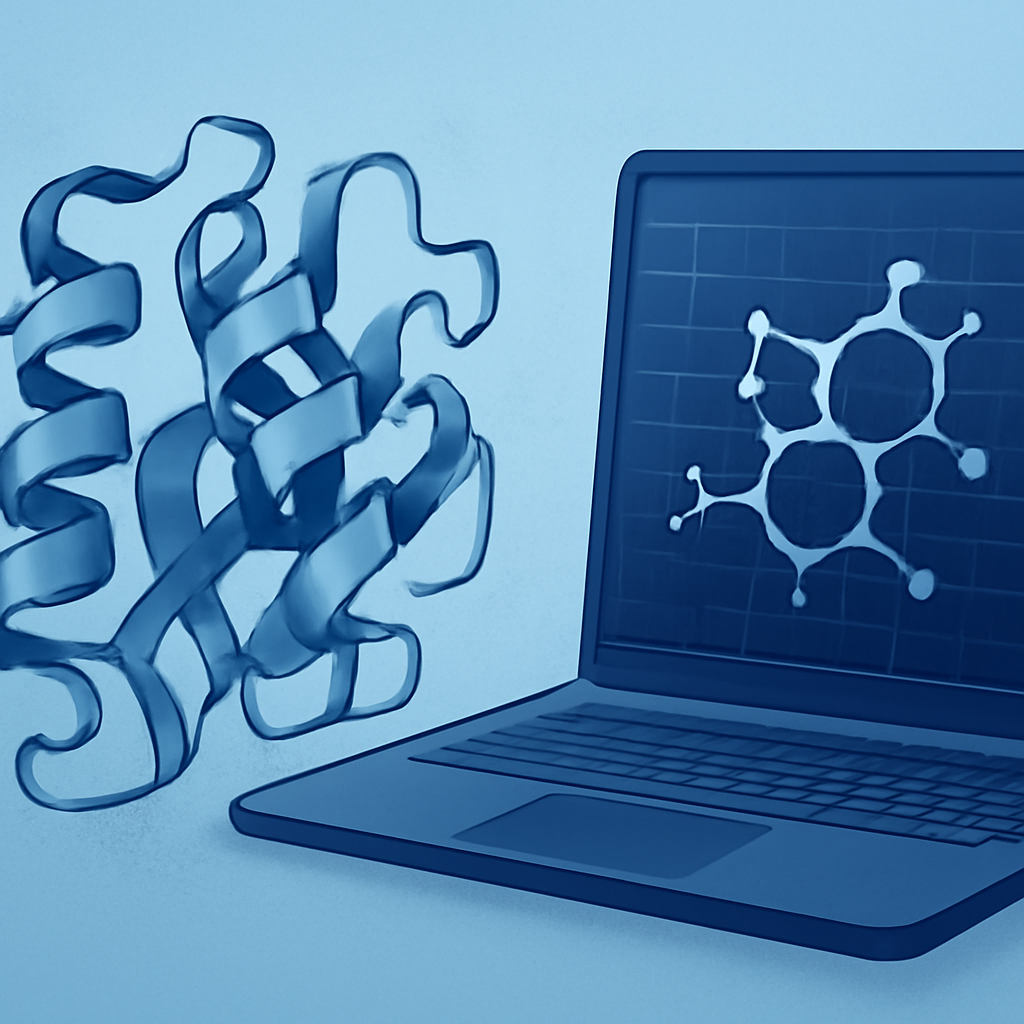
OpenAI says its latest GPT-6 family models show promising GPT-6 protein design capabilities, producing three-dimensional protein backbones and proposing amino-acid sequences from natural-language prompts, general reasoning and general-purpose code rather than by directly invoking specialized biology models. In a preprint titled “GPT-6 as a Universal Foundation Model for Protein Biology: Beyond Specialized Models,” the company reports internal evaluations and laboratory experiments with partner Onava that produced early evidence of binding for designs generated by the models.
According to OpenAI, the GPT-6 models combine mathematical, physical and chemical reasoning with knowledge of recurring patterns in protein sequences and structures to perform tasks normally handled by specialized tools. The research team used the models to tackle a range of protein-design subtasks: designing minibinder shapes, scaffolding functional motifs into full proteins, docking small molecules, redesigning antibody binding loops and ranking the effects of sequence mutations.
OpenAI reports that GPT-6 models produced three-dimensional backbone designs directly from prompts. For laboratory testing, those backbones were converted into amino-acid sequences using specialized sequence models such as SolubleMPNN and ProteinMPNN. The company then applied structure-prediction and selection filters to prioritize candidates for synthesis and testing by Onava.
In one experimental campaign, GPT-6.2 generated backbone designs for minibinders against five protein targets. OpenAI and Onava synthesized 322 minibinders based on GPT-6.2 designs; 35 of these (10.9%) tested positive for binding. The hit breakdown by target was PD-L1 (5 hits), IL-7Rα (3), TrkA (1), VEGF-A (8) and IL-17A (18). OpenAI cautions that hit rates depend on selection filters and the chosen definitions of binding, and it compares these figures to prior work with specialized models.
A second set of lab tests asked GPT-6.2 to propose new amino-acid sequences for known or unpublished minibinder structures. For published-like minibinders, initial screens returned binding rates of 85% (75 of 88) for MDM2, 62% (26 of 42) for VEGF-A and 14% (8 of 59) for PD-1. For three unpublished backbone shapes, GPT-6.2’s sequences produced 14 binding hits out of 107 designs (13.1%). OpenAI highlights that many proposed sequences differed substantially from originals, arguing this reduces the likelihood that positive results simply reflect memorization.
The company also evaluated antibody redesign. For six VHH antibodies targeting IL-4Rα, 128 of 182 redesigned loop constructs (70%) showed binding. In a separate experiment that altered roughly half the amino acids in three binding loops across five therapeutic antibodies, 179 of 272 fragments (66%) retained binding to their original targets (PD-1 or PD-L1).
On computational benchmarks, OpenAI reports that GPT-6 models matched or outperformed specialized models on many design subtasks while still lagging on end-to-end structure prediction. Examples cited in the preprint include motif scaffolding—where an internal GPT-6 model succeeded on 43.7% of 30 MotifBench challenges versus 27.8% for RFdiffusion—and fold-guided design, in which the latest internal model passed 18.9% of 200 challenges versus 17.1% for Proteina.
On small-molecule docking, GPT-6.2 closely matched experimental ligand positions in 93% of PoseBusters-scored predictions (96% for the latest internal model), compared with 50% for DiffDock-L. When provided the identity of a tethering bond, GPT-6.2 matched experimental structures in 92% of Scarpino cases (97% for the latest internal model), against 60% for DiffDock. Antibody-docking performance improved across model generations—mean DockQ scores rose from roughly 0.05 (GPT-5.6) to 0.28 (GPT-6), 0.57 (GPT-6.2) and 0.81 (latest internal model) at peak compute settings.
On mutation-effect ranking, reported rank-correlation scores on a stability dataset climbed from 0.41 (GPT-5.6) to 0.52 (GPT-6), 0.57 (GPT-6.2) and 0.66 (latest internal model). OpenAI reports that GPT-6.2 and the internal model outperformed the specialized ESM2-650M on average across the datasets it evaluated. By contrast, structure-prediction performance—measured by TM-score—remained a relative weakness: scores improved from 0.16 (GPT-5.6) to 0.26 (GPT-6.2) and 0.38 (latest internal model) but were well below the specialized ESMFold2, which was reported at about 0.93 on average.
OpenAI emphasizes several important limitations. The reported design campaign relied on specialized structure-prediction and sequence-selection models to filter and rank candidates, so the results do not demonstrate fully zero-shot, end-to-end minibinder generation without domain-specific tools. The company also underscores that laboratory binding is an early signal of potential function but does not establish specificity, stability, activity or therapeutic utility.
Looking ahead, OpenAI says it will continue work to find minibinders for more challenging targets, design functional effects downstream of binding and broaden the range of molecular types modeled. The preprint also highlights biosecurity considerations and points to OpenAI’s Preparedness Framework for assessing and reducing misuse potential.
The preprint and report provide an early view of how large, generalist models might be applied to protein biology tasks historically dominated by specialized tools, while also making clear that domain-specific components and careful experimental follow-up remain central to producing and validating functional biomolecules.
Source: Read the original source
Leave a Reply