
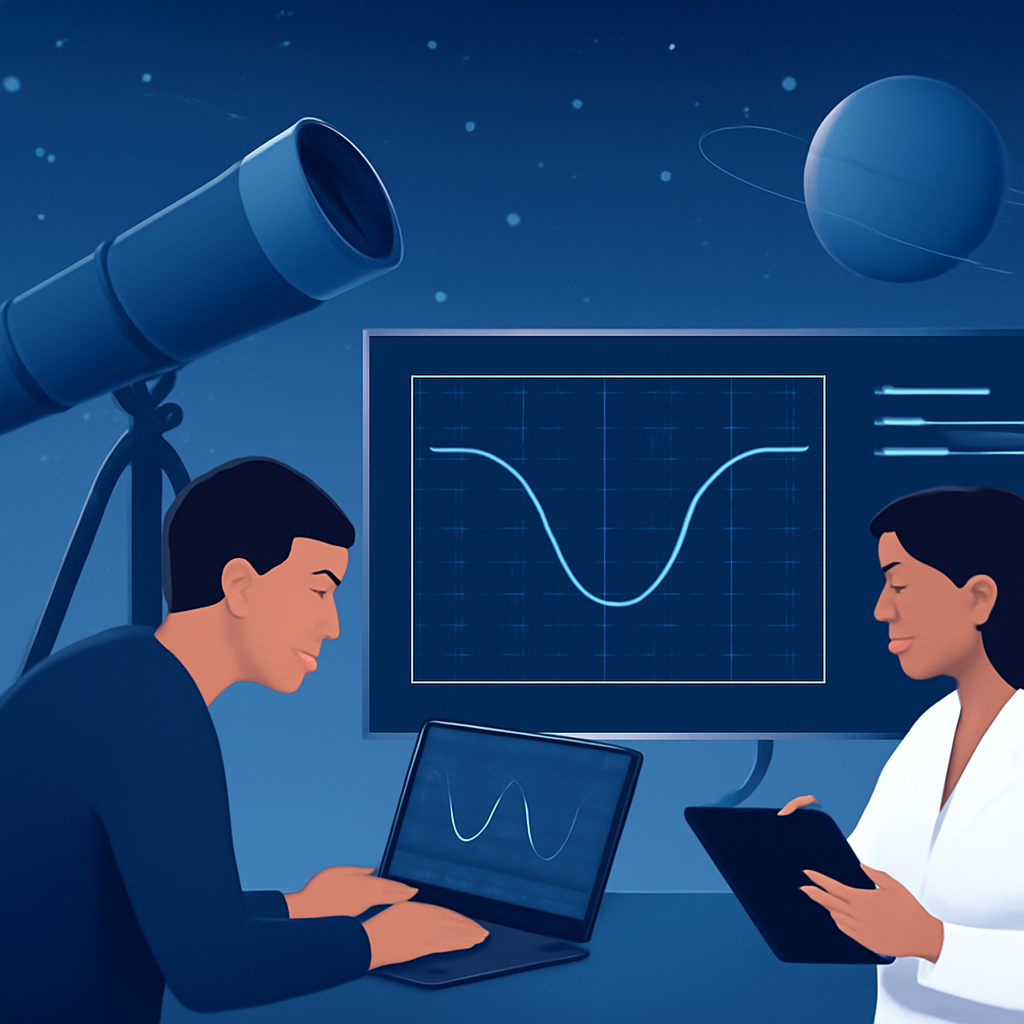
Using Astra and Codex, two amateur astronomers have sifted through public Kepler and TESS data to surface multiple candidate exoplanet signals now under professional review. The projects demonstrate how accessible AI tools can help non-professional researchers run large-scale searches, apply published detection techniques, and provide concrete leads for follow-up by the astronomical community.
The two efforts took different technical approaches. Kevin Bond, an OpenAI engineer and astrophotographer, employed OpenAI’s Codex to analyze light-curve data from roughly 100,000 stars observed by the Kepler Space Telescope. Bond instructed the model to implement established detection methods, combine them into a processing pipeline, and iterate on code changes. In his workflow, one agent scanned for transit-like signatures while another performed more detailed vetting of promising candidates.
Independently, Ethan Byrd, founder of the Primitive email infrastructure startup, used Astra to automate his searches. Byrd built two complementary workflows: a broad scan for transit candidates and a targeted search concentrating on stars’ habitable zones. He ran those workflows over datasets from NASA’s Transiting Exoplanet Survey Satellite (TESS) and other public archives.
Both teams relied on the transit method, which identifies small, recurring dips in a star’s brightness when an orbiting body crosses the stellar disk from Earth’s viewpoint. These projects build on earlier machine-learning applications in exoplanet science, such as a 2017 study that trained neural networks on Kepler signals and helped reveal additional planets in known systems.
Bond’s Codex-driven pipeline produced more than 200 candidate signals and successfully recovered ten previously confirmed planets, a result that helped validate his approach. Two targets from his search drew particular attention. KIC 5689121, a relatively cool star about half the Sun’s size in Lyra, showed a recurring dip every 13.8 days; the transit depth, if planetary in origin, implies a body roughly 2.4 times Earth’s diameter. A second target, KIC 6691030, a faint northern star, exhibited dips every 4.8 days consistent with a planet smaller than Neptune.
An independent search of the Kepler data by a SETI Institute astronomer located the same two signals Bond reported. Vishal Gajjar, associate director for international SETI programs, said Bond’s pipeline “has surfaced promising candidates in data traditional searches may have missed,” and noted that initial checks are encouraging while follow-up observations will determine the signals’ true nature.
Byrd’s Astra-based searches yielded an initial list of 49 candidates. He has already submitted one of his strongest candidates to researchers working on the TESS mission for further analysis, with two additional promising signals awaiting submission. Byrd’s broader scan is continuing as he refines workflows and expands the datasets under review.
Professional astronomers now face the work of vetting these candidates. Confirming an exoplanet requires ruling out alternative explanations for brightness dips, such as eclipsing binary stars, instrumental artifacts, or thermal variations on telescopes. Teams use statistical vetting, timing repeated transits, and independent observations to build confidence. Follow-up techniques include predicting and observing future transits and conducting radial velocity measurements—often via spectroscopy—to detect a star’s slight motion due to an orbiting companion.
The validation process can be lengthy. Confirming a candidate may take months or even years, as observers schedule targeted observations at predicted transit times and pursue detailed spectroscopic checks to weigh possible explanations.
Beyond these specific finds, the projects highlight how AI tools like Astra and Codex can extend the reach of citizen scientists and hobbyist astronomers. By automating code development, executing large searches, and performing initial vetting, such tools allow individuals to probe extensive public archives for signals that more conventional searches might overlook.
Members of the public who want to participate need not own large telescopes. NASA’s Exoplanet Watch offers tools and tutorials for plotting light curves, and coordinated citizen-science programs such as the AAVSO Exoplanet Observing Program and the Unistellar network let observers contribute transit observations for scientific use.
Bond and Byrd’s efforts remain active and serve as contemporary examples of a longstanding astronomical tradition: curious people around the world combing archived data and sharing findings. Their candidate lists now provide tangible leads for professional teams to investigate, and the coming months will determine which of these signals—if any—represent new worlds.
Source: Read the original source
Leave a Reply