
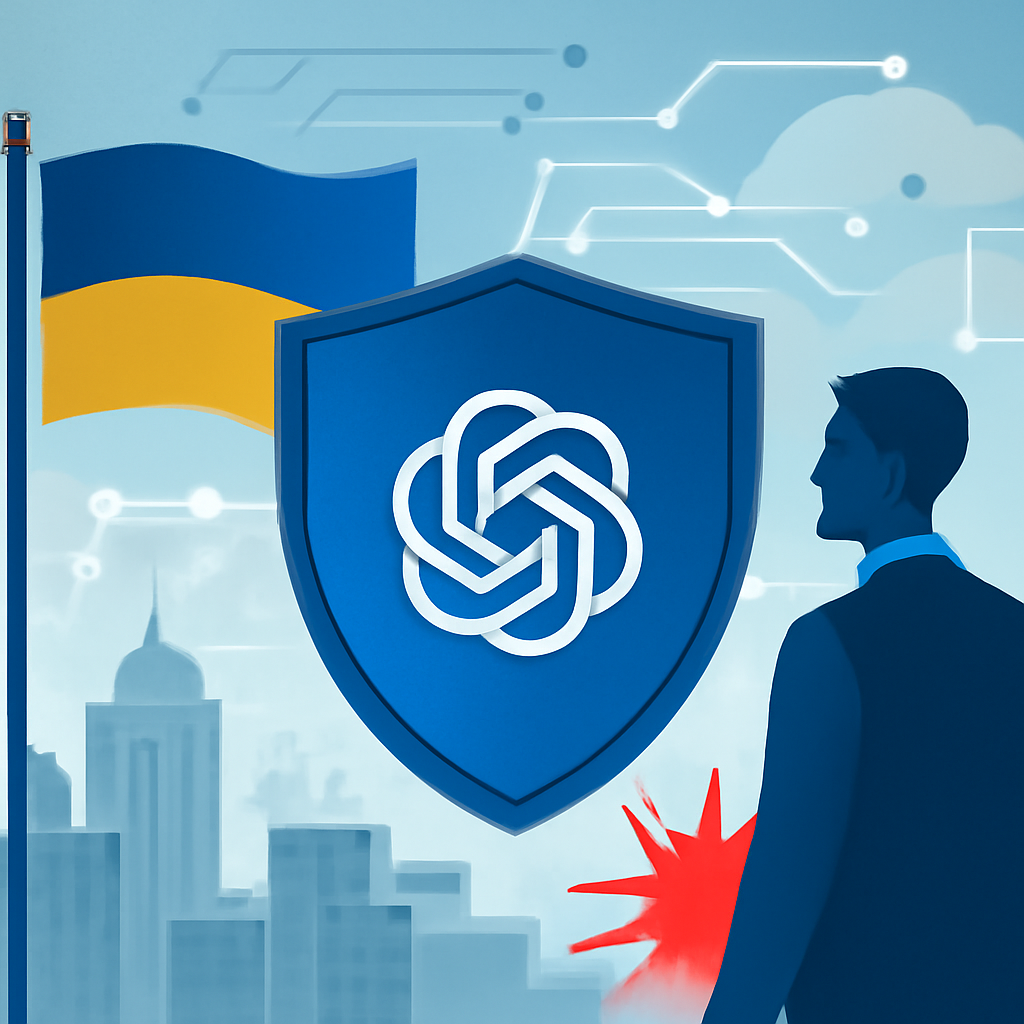
OpenAI said it will provide Daybreak access to Ukraine to help the country defend civilian infrastructure against persistent cyber threats, announcing the move on the sidelines of the UN General Assembly. The offering, arranged with Ukraine’s Ministry of Digital Transformation, will give Ukrainian teams AI-assisted tools designed to accelerate the discovery and remediation of software vulnerabilities that could disrupt essential services.
The announcement was made by Dmytro Kushneruk, Consul General of Ukraine in San Francisco, alongside Sasha Baker, Head of National Security Policy at OpenAI. According to the company, the Daybreak platform supplies authorized cyber defenders with advanced AI capabilities to assist with reviewing legacy code, investigating suspicious activity, validating identified vulnerabilities and testing fixes before deployment.
OpenAI framed Daybreak as a proactive tool for public and private defenders, enabling them to strengthen systems in advance of attacks rather than react after incidents occur. In its statement, the company emphasized that the platform is intended for authorized security work and positioned the assistance as targeted support for critical civilian systems that face both digital and physical pressure.
The decision to extend access to Ukrainian teams arrives amid intense and sustained cyber pressure on the country’s infrastructure. OpenAI cited statistics from Ukraine’s national cyber incident response team, CERT-UA, noting the agency handled nearly 6,000 cyber incidents in 2025. Those incidents reportedly targeted hospital systems, energy networks and telecommunications providers, putting strain on organizations that deliver essential services to civilians.
Sasha Baker highlighted the urgency of the assistance, saying the support aims to help Ukrainian cyber defenders protect essential services against daily attacks and to shore up defenses before new threats materialize. OpenAI described the move as part of a broader national security-focused effort that recognizes cyber defense as a central element of protecting civilian infrastructure.
OpenAI also placed the Ukraine rollout in the context of prior access granted to several European countries, including France, Germany and Poland. The company noted that the EU’s cybersecurity agency, ENISA, used the models to identify vulnerabilities in software used across EU institutions, and that those issues were subsequently fixed. In Poland, CERT Polska reportedly used OpenAI’s models to discover six vulnerabilities in third-party router software; OpenAI said the vendor released patches that address the problems and that CERT Polska confirmed the fixes prevent observed attacks.
George Osborne, Head of OpenAI for Countries, argued that Ukraine’s experience underscores the need to treat cyber defense as an integral part of national security and that protecting civilian infrastructure requires action on both the physical and digital fronts. OpenAI stressed the program’s emphasis on working with authorized defenders and public-private partnerships to identify and remediate vulnerabilities that could cause disruption to essential services.
While OpenAI outlined the capabilities Daybreak provides—AI-assisted review, investigation, validation and testing—the company did not disclose detailed technical or operational information about deployment timelines, access conditions or the exact tools that will be available to Ukrainian teams. The announcement therefore sets expectations about intent and capability without specifying the mechanics of delivery or the scope of integration with Ukraine’s existing cyber defense operations.
For Ukraine, access to Daybreak represents an additional resource to augment national cyber response efforts already under significant strain. By supplying AI-assisted workflows intended to speed vulnerability discovery and testing, OpenAI framed the offering as timely support for a country described in its statement as being on the front line of both digital and physical attacks on infrastructure.
The move highlights a growing trend of technology providers positioning advanced AI tools as resources for national and regional defenders, particularly for tasks that require rapid analysis of code and systems at scale. OpenAI’s extension of Daybreak access to Ukrainian teams follows its earlier collaborations with European defenders and reinforces the company’s stated approach of enabling authorized defenders to proactively secure critical civilian systems.
Looking ahead, the impact of this initiative will depend on how quickly and effectively Ukrainian agencies integrate Daybreak into existing security processes, how access and authorization are managed, and whether the platform can be applied safely and responsibly in high-stakes environments. OpenAI’s announcement signals a commitment to offering AI-assisted cyber defense tools to governments and agencies, while also leaving open key operational details that will determine how the support is implemented on the ground.
Conclusion: OpenAI’s provision of Daybreak access to Ukraine aims to bolster defenses for critical civilian services by putting AI-assisted vulnerability discovery and remediation tools in the hands of authorized Ukrainian teams. The announcement underscores the role of AI in contemporary cyber defense efforts while noting that practical deployment specifics remain unspecified.
Source: Read the original source
Leave a Reply