
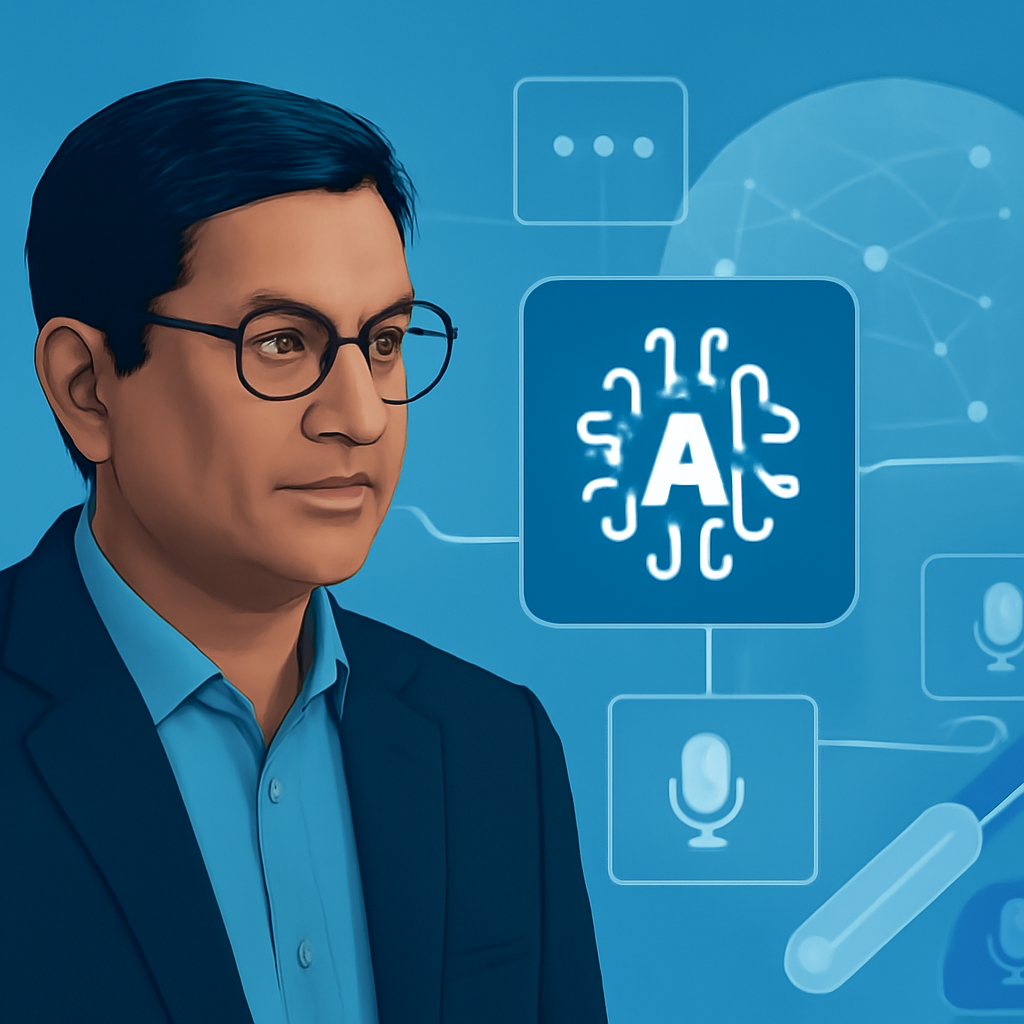
JioStar has deployed an AI-powered conversational assistant for JioHotstar that demonstrates practical AI discovery at massive scale. Built with the OpenAI API, the assistant accepts natural voice queries in more than 15 languages and returns results through a visual, conversational interface tailored to entertainment viewers and cricket fans. The system is designed to serve more than 500 million consumers and to support two distinct discovery needs: broad, mood-based recommendations for general viewers and precise event- and stat-based retrieval for sports fans.
The project moved from concept to production in roughly eight weeks to coincide with a major cricket tournament. Work began in October and November, and JioStar prioritized scope tightly to meet the February deadline. That focus included explicitly limiting what the assistant would not handle and establishing operational guardrails before expanding capability. A small cross-functional team, paired with collaboration from forward-deployed OpenAI engineers, enabled rapid iteration and an on-schedule launch.
At JioStar’s scale, engineering decisions were driven by a three-way tradeoff among accuracy, latency and cost. Voice interactions intensified these constraints: more than 60% of the product’s users rely on voice rather than text, creating a need for responses that are simultaneously relevant, fast and economically sustainable at high volume. The product design embedded that balance at each stage, prioritizing computational efficiency and response relevance while controlling latency to meet viewer expectations.
Evaluation and validation were central to the development process. JioStar adopted a two-part approach: an evaluation framework to guide system changes, and a validation layer that converts production behavior and failures into new evaluation cases. In practice, customer interactions and observed failures feed back into the test suite, allowing the team to refine the assistant based on real-world usage rather than only synthetic prompts.
Domain expertise played a crucial role in shaping reliable evaluations. For sports-statistics checks, JioStar worked with sports-magazine editors and other specialists to anticipate the questions serious fans would ask. The team seeded the system with human expertise rather than relying solely on prompt engineering, ensuring that evaluation cases reflect the depth and specificity of actual user intent.
To accelerate test generation and iteration, the team employed a maker-checker pattern using models: one model suggested candidate answers while a second model acted as a validator or judge with a different objective. Designing the judge required its own evaluation work—deciding what or who verifies the validator—so automated acceleration did not eliminate the need for human judgment. JioStar emphasized that model-driven tooling can increase throughput, but human validators remain essential for reliability.
Production readiness extended beyond traditional infrastructure metrics. While P99 latency and other service-level indicators remained important, Chief Architect Vijay Seshadri stressed the separate necessity of monitoring model efficacy in production. In retrospect, he noted that earlier investment in monitoring model performance would have been beneficial. The team used tooling such as Codex to speed tasks like generating evaluation cases and updating the system, but these tools were framed as accelerants rather than replacements for careful validation.
Seshadri also offered guidance to executives: recognize the gap between raw model capabilities and enterprise readiness. Organizations should emphasize measurable outcomes rather than activity measures—lines of code or generated prompts do not necessarily indicate meaningful value. Moreover, successful production deployments require people with the right skills to apply AI tools with validation and guardrails. Generic training programs are insufficient; enterprises need staff who can translate model outputs into reliable, auditable production behavior.
JioStar’s implementation underscores a pragmatic route for deploying generative AI at scale: narrow the initial scope, embed robust evaluation and validation processes, involve domain experts early, and invest in production monitoring to ensure models remain effective and reliable. The project demonstrates that AI discovery can be made operational for hundreds of millions of users when engineering tradeoffs, human expertise and monitoring are treated as first-class responsibilities.
As organizations consider similar launches, JioStar’s experience provides a clear set of operational priorities: define boundaries, measure outcomes, maintain human-in-the-loop validation, and build monitoring that tracks not only infrastructure but model efficacy in production. Those steps, taken together, help convert promising model capabilities into dependable user-facing systems.
Source: Read the original source
Leave a Reply