
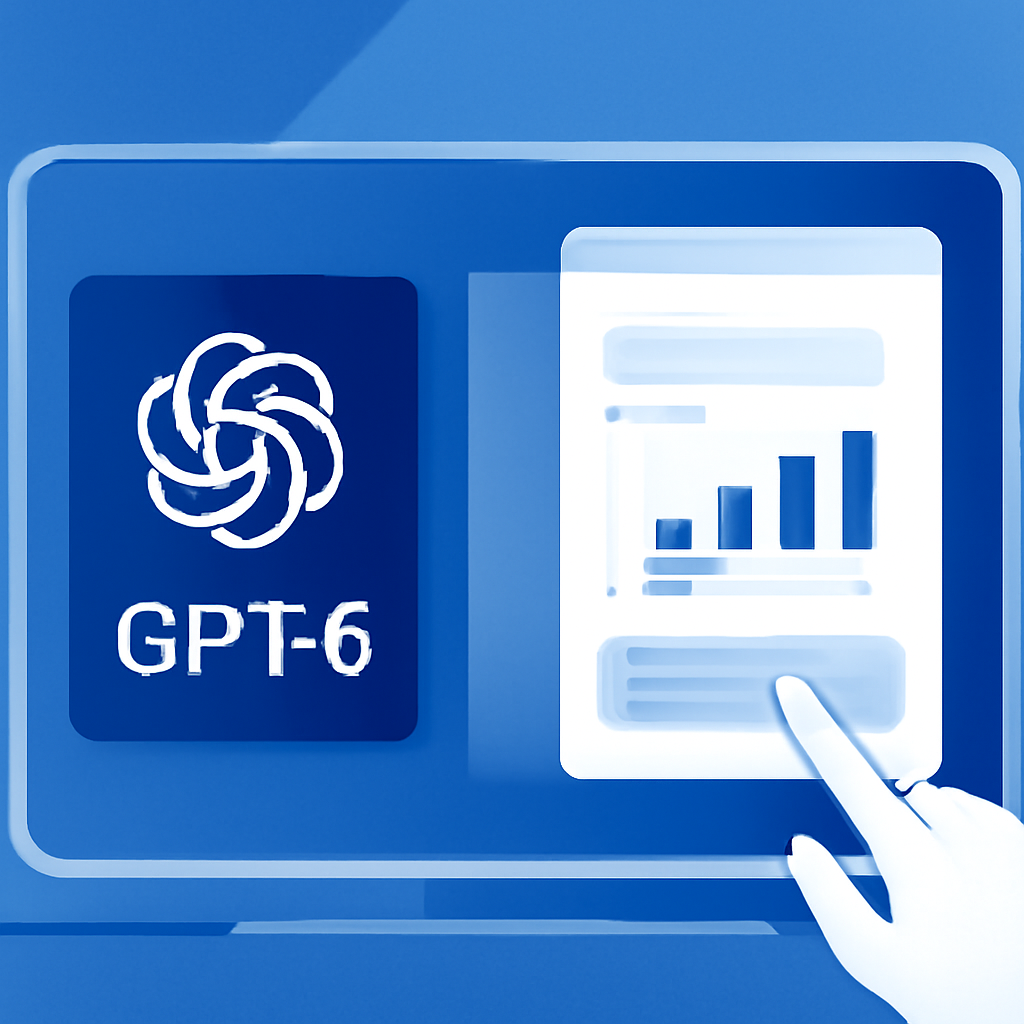
OpenAI has begun a global rollout of GPT-6 inside ChatGPT, pairing the new model with an Intelligent UI that blends text, visuals and interactive elements to produce faster, more manipulable responses. The company says the update reaches the more than 1.2 billion people who use ChatGPT each week and is available across Free, Go, Plus, Pro, Business and Enterprise tiers according to account settings.
The Intelligent UI enables GPT-6 to select the most useful format for a given question, combining prose with graphics, tappable buttons, forms, charts and other interactive components. OpenAI presents examples such as side-by-side comparisons, interactive diagrams that clarify explanations, or compact text when brevity is preferable. The assistant can also generate simple in-chat tools on demand — savings calculators, bill splitters or small games — letting users manipulate inputs and explore results without leaving the conversation.
Under the hood, OpenAI supplied GPT-6 with a library of native, streamable UI components and a compiler that progressively renders interfaces while the model generates them. The component library gives responses a consistent design baseline, and the compiler allows partial interfaces to appear as output streams, so users begin to see useful content sooner rather than waiting for a final, complete response. During training, OpenAI expanded evaluation criteria for model output to include layout, visuals and interactivity, encouraging GPT-6 to choose formats that improve clarity and usefulness.
GPT-6 also introduces a streaming approach to composing answers: it can start delivering usable content while continuing to refine and update the response. OpenAI reports that GPT-6 Instant begins answering on average 44% sooner than GPT-5.6 Instant for queries that require web search. In internal evaluations of complex, everyday agentic tasks, GPT-6 Extra High began answering within the same time as GPT-5.6 Medium while achieving a higher overall score than GPT-5.6 Extra High. The company further says GPT-6 makes better decisions about when to consult the web and more reliably finds supporting information for its replies; in internal testing on difficult problems, GPT-6 more often addressed the key aspect of a user’s question than GPT-5.6.
OpenAI describes the Intelligent UI and streaming composition as steps toward assistants that can generate task-specific interfaces on demand, shifting interaction away from a single conversational format toward responses tailored with visual and interactive elements. By enabling the model to determine when a diagram, a chart or a compact text block is most helpful, the company aims to reduce the need for users to adapt to fixed software interfaces.
Safety and adversarial robustness were also priorities in GPT-6’s development. OpenAI says the model builds on prior safety work — including techniques referenced as Astra’s advances — and includes updated training intended to better resist misuse attempts, follow safeguards, and clarify its limitations compared with GPT-5.6 Sol. The company reports strengthened protections for high-risk misuse scenarios involving cyberattacks, biological threats and violence, and says GPT-6 showed stronger resistance in adversarial, multi-turn testing. Alignment evaluations during training focused on honesty and adherence to restrictions, and OpenAI notes the model is better at recognizing and communicating when it lacks sufficient information or tools.
Technical details and evaluation results are available in the model’s system card, which OpenAI published online. The company also clarified deployment details: ChatGPT’s Chat tab is being powered by GPT-6 Sol for Plus, Pro, Business and Enterprise customers and by GPT-6 Luna for Free and Go users. The paid-tier rollout began on the day of the announcement, with Free and Go tiers scheduled to receive the update starting the following day. OpenAI added that Enterprise access may be subject to workplace administrator settings. Models used for Work and Codex were not changed as part of this release.
Taken together, the model and the Intelligent UI point to a broader design shift in conversational AI: rather than returning only static text, assistants can construct partially interactive, streamable interfaces that let users probe, adjust and act on results in the same chat. OpenAI frames this release as an early step in enabling assistants to generate task-specific interfaces on demand, a capability that could reshape how people use conversational systems for everyday tasks.
OpenAI’s rollout of GPT-6 and the Intelligent UI therefore reflects both performance and interaction ambitions: faster, more web-aware answers delivered in formats the model judges most helpful, alongside measures aimed at improving safety and resisting adversarial misuse. For now, users across Free to Enterprise tiers will begin to encounter these capabilities in ChatGPT’s Chat tab as the rollout proceeds.
Source: Read the original source
Leave a Reply