
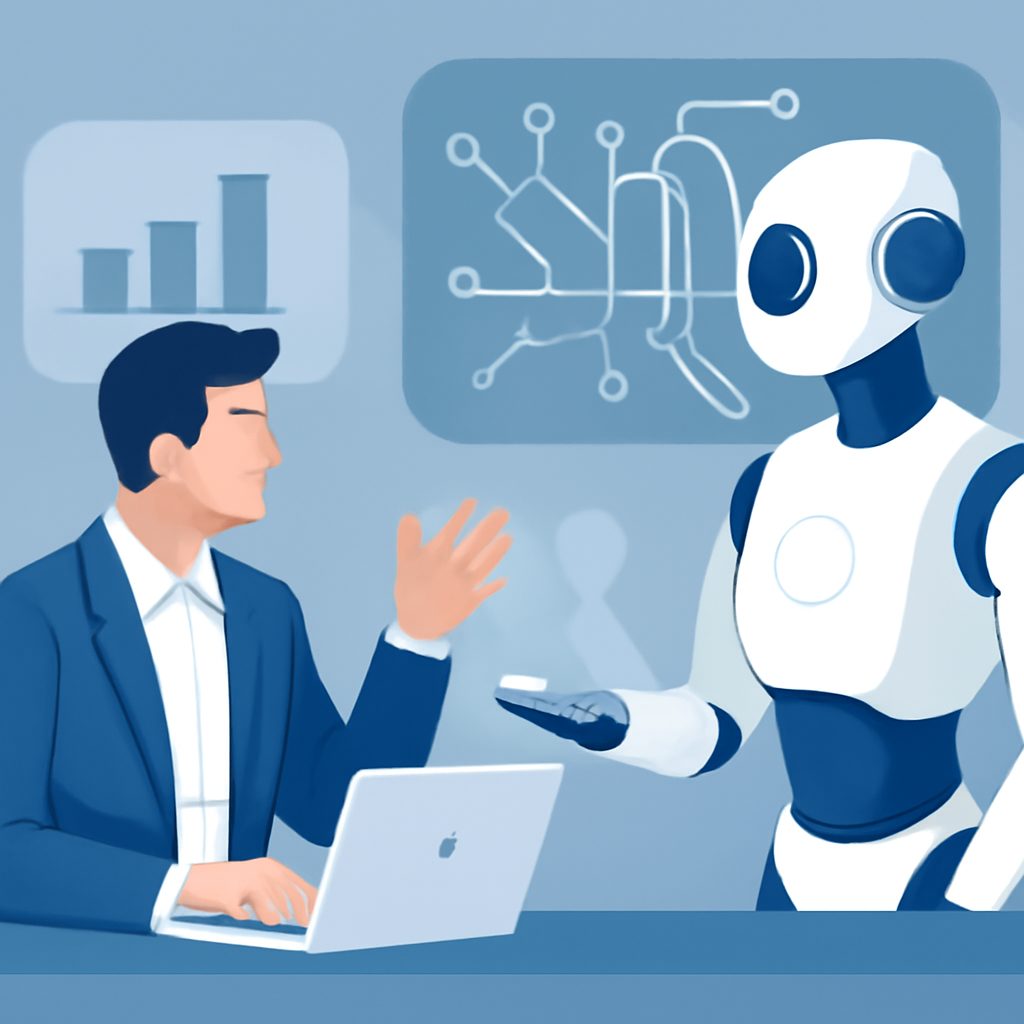
OpenAI’s essay, “The future of the firm,” maps three stylized ways that artificial intelligence could integrate into companies: beneath human workers as subordinate agents, beside humans as peer colleagues, and between humans as a coordinating layer. The paper presents these scenarios as frameworks for understanding how firms might evolve into hybrid organizations as AI capabilities improve and adoption spreads across the economy.
The first scenario—AI beneath us—imagines a new layer of subordinate agents serving existing employees. In this model, frontline workers retain their positions but are supported by AI “underlings” that take on routine drafting, data work, scheduling and other repetitive tasks. Over time these agents may coordinate among themselves, form subteams and require oversight, effectively turning each worker into a manager of a small, AI-assisted unit. OpenAI highlights that this path to adoption is likely to begin with those closest to the work: entry-level employees and individual contributors who can best supervise and train their AI counterparts. Rather than producing immediate layoffs, the paper argues, this form of automation can transform task-level work into higher-order responsibilities such as coordination, creativity and management.
The second scenario positions AI beside us as peer members of teams. Here, managers assign work to AI groups in much the same way they do to human employees. For example, an AI marketing team might plan campaigns, coordinate with manufacturing and prototype creative concepts, producing output that sits alongside human-generated work. The essay stresses that the scope of AI capabilities matters: narrow specialized tools are harder to adopt at scale because they demand widespread retraining, whereas broader, end-to-end AI functions that can manage whole jobs or teams are easier for executives to accept and deploy. Because most economic output emerges from teams and firms rather than lone individuals, AI that can operate at team or firm scope will be particularly consequential.
The third scenario places AI between us as an organizational coordinating layer. In this model an AI serves like an always-on internal consultant, scanning documents, communications and project threads to surface risks, recommend reassignments and highlight underrecognized contributions. Executives would receive proactive analysis and be able to act sooner on emerging problems. Rather than directly replacing managers, these internal consultancies shorten information frictions between the C-suite and the organization and centralize visibility. According to the essay, such tools could increase executive control and accelerate AI adoption across the firm, while also enabling greater trust in decentralized work if monitoring systems reliably recognize progress toward objectives.
OpenAI’s treatment of these three paths is deliberately analytical rather than predictive. The authors present them as lenses for thinking about a transitioning economy in which small, worker-led experiments may precede top-down executive deployments. The paper draws attention to four central organizational questions that follow from these scenarios.
First, will bureaucratic overhead decline as prototyping becomes cheaper? If AI reduces the cost of trial-and-error, firms may shift norms toward faster experimentation and lighter planning ceremonies. Second, will workers gain or lose agency? The essay suggests an ambiguous effect: AI advisers and monitors could reduce micromanagement and grant employees more autonomy, but the same systems might be used to enforce executive preferences more rigorously. On balance the authors expect some increase in worker agency because AI can surface exceptions and allow routine choices to remain decentralized.
Third, how will firm boundaries change? Improved coordination enabled by AI could justify larger, more integrated firms, yet enhanced monitoring and contractibility might encourage reliance on outside suppliers and a proliferation of smaller firms. The essay foresees both outcomes: a landscape with many smaller, specialized companies alongside a few sprawling, AI-driven conglomerates. Finally, what happens to pay inequality? If high-quality AI advice becomes widely available, differentiation could compress; conversely, those who manage large AI-driven operations effectively may capture outsized value, widening pay gaps. Which of these forces predominates will depend on whether human roles continue to emphasize judgment and scope or primarily follow AI guidance.
Why this matters is the paper’s closing point: organizational choices made today will affect career trajectories, management practices and the allocation of value in an AI-augmented economy. By sketching the beneath, beside and between scenarios, OpenAI offers a structured way to anticipate both practical adoption paths and the broader institutional effects of integrating AI into firms.
The essay serves as a prompt for leaders, employees and policymakers to consider not only the technical capabilities of AI but also the managerial and structural trade-offs that will shape workplaces in the years ahead.
Source: Read the original source
Leave a Reply