
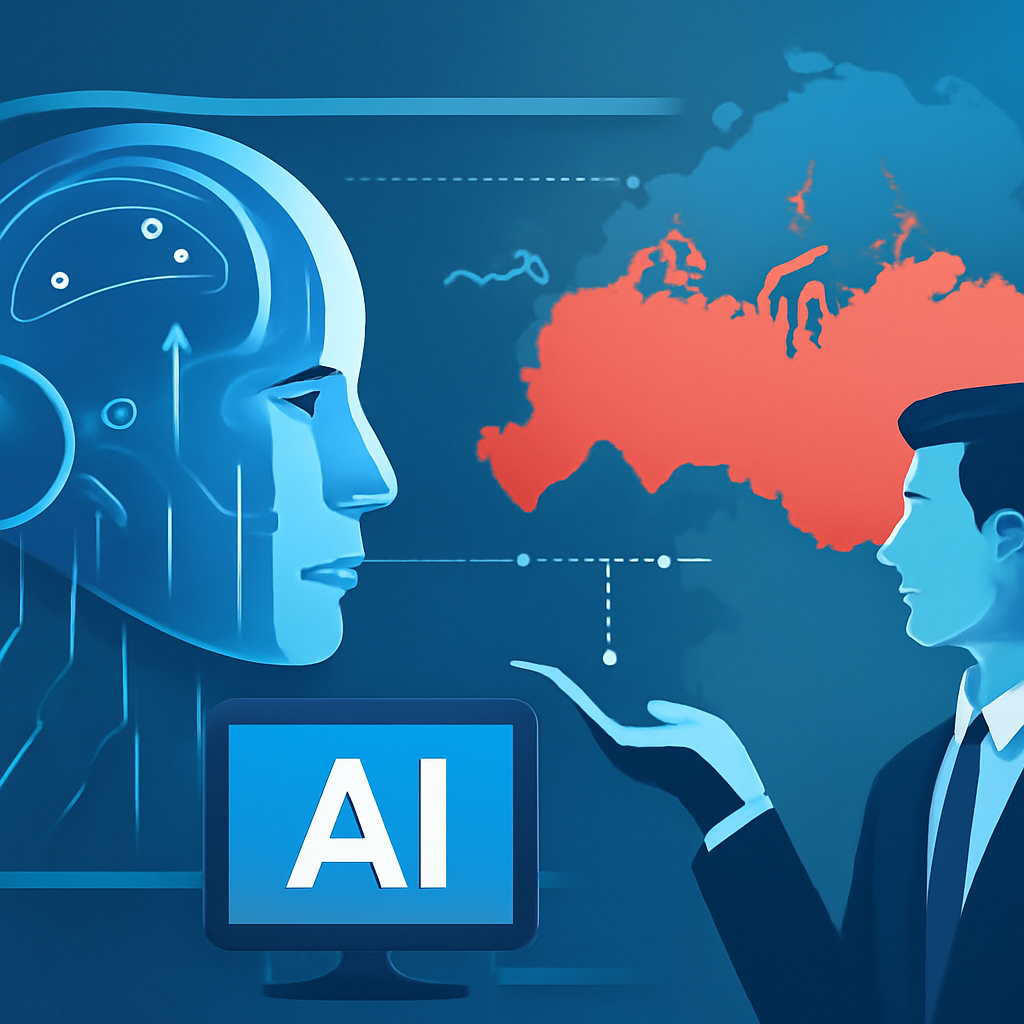
Visual concept for article
Core idea
A crisp, news-hero illustration that communicates a coordinated, AI-powered influence operation originating from Russia, promoting a fabricated Israel-based think tank and a manipulative “sovereignty” index, and the platform-level response by OpenAI to disable the operation.
Composition
– Central focal element: a stylized digital feed or dashboard (wide horizontal screen) showing multiple content tiles. Several tiles carry subtle, generic headlines or short labels such as “sovereignty index” and “think tank report” (no verbatim claims or quotations). The tiles should look algorithmically generated—repetitive layout, near-identical phrasing blocks, and slight watermark-like “AI” markers.
– Left cluster: a network graph of account nodes and distribution lines radiating outward. One cluster is anchored by a labeled origin marker: “Russia (origin)” to reflect the source information. The graph’s nodes are small avatars or account icons to convey coordination and scale.
– Right cluster: a discrete “moderation” panel showing action taken. A shield icon labeled “OpenAI” (text only, no logo) overlaps several account nodes and a bold red “Disabled / Banned” stamp appears on some of the tiles. This communicates platform intervention without implying any visual trademark use.
– Bottom / overlay infographic: a simple pipeline diagram showing “AI generation → Fabricated outlet (Israel-based think tank) → Distribution (bots/accounts) → Influence amplification.” Use arrows and concise labels to explain the mechanism visually.
Color and tone
– Palette: restrained, high-contrast newsroom colors—midnight blue or charcoal for background, bright cyan or electric blue for digital/UI highlights, muted red for warning/banned elements, and neutral grays for content tiles.
– Tone: investigative and urgent but factual—avoid sensational flourishes. Clean typography and flat vector elements reinforce a serious, tech-focused aesthetic.
Iconography and symbols
– Use generic AI/robot icons, data/network nodes, document or report icons for the fabricated think tank content, and a gauge or bar labeled “sovereignty index” to represent the manipulated ranking. Do not create or display any real organization logos.
– Represent Western countries generically (e.g., a clustered set of simplified flag silhouettes or an icon labeled “West”) to reflect the article’s mention that the content criticized Western countries.
Layout variants
– Hero image for web article: full-width banner with the central dashboard and the network graph on the left, moderation panel on the right. Headline space above the image.
– Thumbnail / social card: simplified version showing the network graph with a single “Disabled” stamp and a tiny moderation shield to convey takedown at a glance.
– Infographic panel for story body: the pipeline diagram with short captions expanding on how generative AI can be repurposed for coordinated influence operations.
Accessibility and guidance
– Ensure strong contrast for readability; provide alt text describing the scene and its main elements for screen readers (e.g., “Network graph of coordinated accounts originating in Russia, AI-generated report tiles labeled ‘sovereignty index’ and ‘think tank,’ and a moderation shield labeled OpenAI marking accounts as disabled”).
– Use clear, legible type (sans-serif) and avoid embedding important text into images; provide the same explanatory labels in the article body.
Suggested deliverables
– 1920×1080 hero illustration (vector + PNG export),
– 1200×630 social card crop,
– Vertical infographic (800×2000) breaking down the AI generation-to-distribution pipeline,
– Accessible alt text and short caption copy for each asset.
Narrative goal
The visual should make it immediately clear that: (1) AI was used to produce and amplify fabricated content tied to a fake Israel-based think tank and a sovereignty index, (2) the operation praised Russia and criticized Western countries, and (3) OpenAI intervened to disable the accounts—illustrating platform-level mitigation against coordinated AI-driven influence activity.
Leave a Reply