
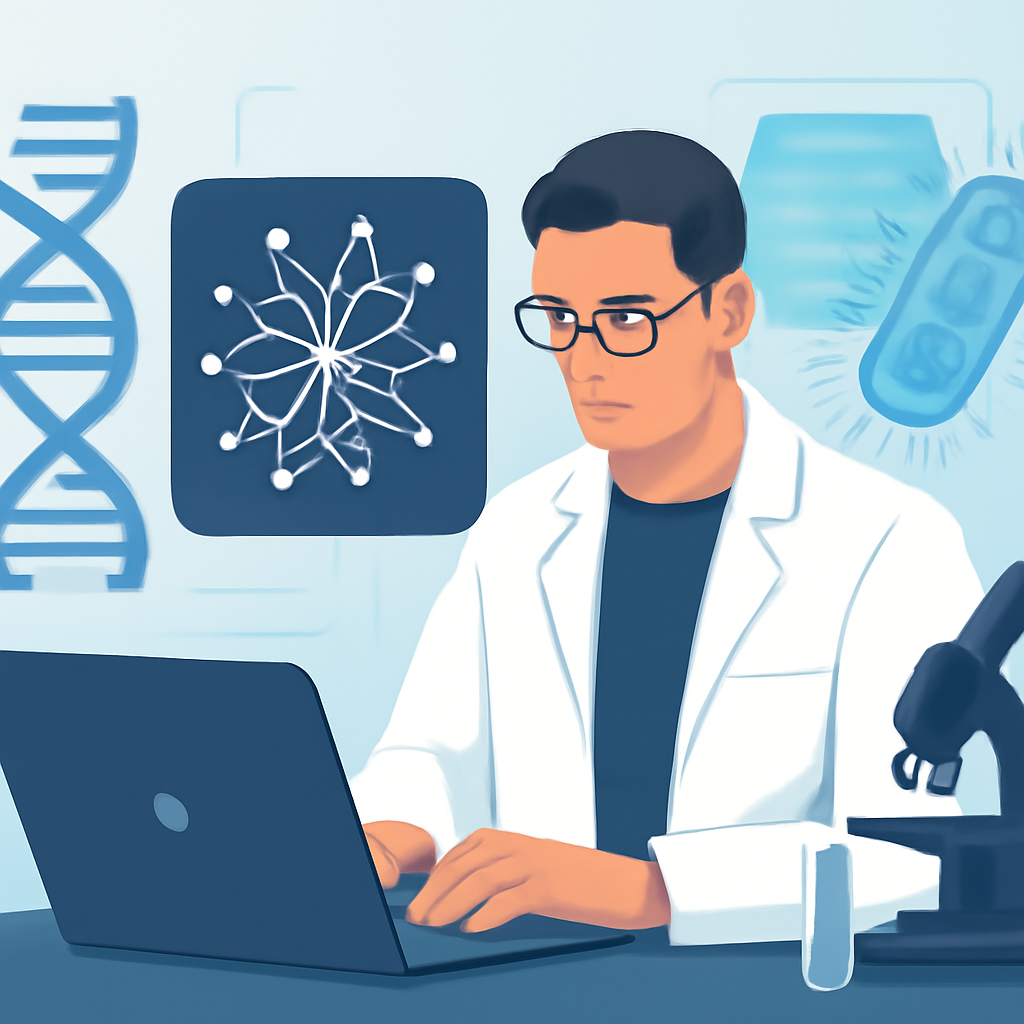
César de la Fuente’s lab at the intersection of biology and engineering uses Codex and ChatGPT as practical tools to accelerate the search for new antimicrobials by treating biological sequences as information. By applying deep-learning models to DNA and protein sequences, the team screens vast genomic and proteomic databases for patterns that suggest antimicrobial potential, compressing what historically took years in the earliest discovery phase down to hours for initial candidate identification.
The lab’s premise is simple but profound: view biology as code. Models are trained to detect sequence features and relationships that correlate with biological activity, and those models then prioritize sequences that merit experimental follow-up. De la Fuente frames this strategy as a route to novel molecular scaffolds that differ from the modifications of familiar drug classes. This approach addresses an urgent public-health challenge—analysis cited by the group links millions of deaths to bacterial antimicrobial resistance and warns that tolls could rise substantially if new solutions are not found.
Codex and ChatGPT are woven into daily workflows alongside bespoke models. The lab employs these tools for hypothesis generation, drafting and refining code, preparing and preprocessing large datasets, and conducting preliminary analyses. That combination lowers disciplinary barriers: biologists can more readily write or interpret code, while programmers can engage with biological questions with greater fluency. Team members also use ChatGPT to review unfamiliar literature, clarify terminology, and organize ideas for drug-discovery efforts, and the tool has facilitated multilingual collaboration by enabling researchers to work in their native languages.
AI’s chief advantage in this setting is scale. Sequence databases are vast, and the task of finding biologically active molecules is a classic needle-in-a-haystack problem. Computational models can sift through enormous datasets and prioritize a manageable subset of candidates for laboratory testing, focusing limited bench resources where they are most likely to succeed. De la Fuente characterizes the lab’s work as transdisciplinary, marrying biology, chemistry, computer science, and engineering, and likens computational tools to instruments such as telescopes and microscopes that open new domains of investigation.
Despite the promise of in silico discovery, de la Fuente underscores that computational outputs are only the beginning of a long pipeline. A candidate sequence identified by models must be validated with ground-truth experiments: tests to confirm it kills the target microbe, assays to determine effective concentrations, and experiments to evaluate safety for human cells. Chemical optimization may then be required to improve potency, stability, or manufacturability before further preclinical testing addresses toxicity, the potential for resistance, pharmacokinetics, and scalable manufacturing. Candidates that clear preclinical stages still require regulatory review and clinical trials before they can become approved medicines. As de la Fuente puts it, “ground-truth experiments are essential to validate AI predictions.”
The lab’s routine use of Codex and ChatGPT highlights how AI can act as a collaborator rather than a replacement for human expertise. Team members use ChatGPT as a brainstorming partner and shared workspace where diverse ideas can be combined and iterated quickly. At the same time, the group maintains a cautious stance: AI outputs must be checked for accuracy and treated as guidance for hypothesis generation rather than as definitive answers.
This workflow also demonstrates practical benefits in collaboration. By making code and biological reasoning more accessible across disciplinary lines, the tools help bridge gaps between computational and wet-lab researchers. They accelerate early-stage discovery, streamline dataset handling, and support multilingual teams—functions that make it easier to move from a computational hit to an experiment-ready candidate.
De la Fuente’s lab remains mindful of limitations: computational screening narrows possibilities but does not obviate the need for rigorous laboratory science. The full journey from a promising sequence to an approved antimicrobial is long and multifaceted. Still, by combining deep learning with tools such as Codex and ChatGPT, the team has significantly reduced the time required to generate testable hypotheses, allowing researchers to focus experimental efforts on the most promising leads.
As antimicrobial resistance continues to pose a mounting public-health threat, approaches that speed early discovery while centering empirical validation may prove essential. The work from de la Fuente’s group illustrates how AI-driven screening can expand the search for new molecular scaffolds in the code of life while underscoring that computational advances must proceed hand in hand with careful laboratory science.
Source: Read the original source
Leave a Reply