
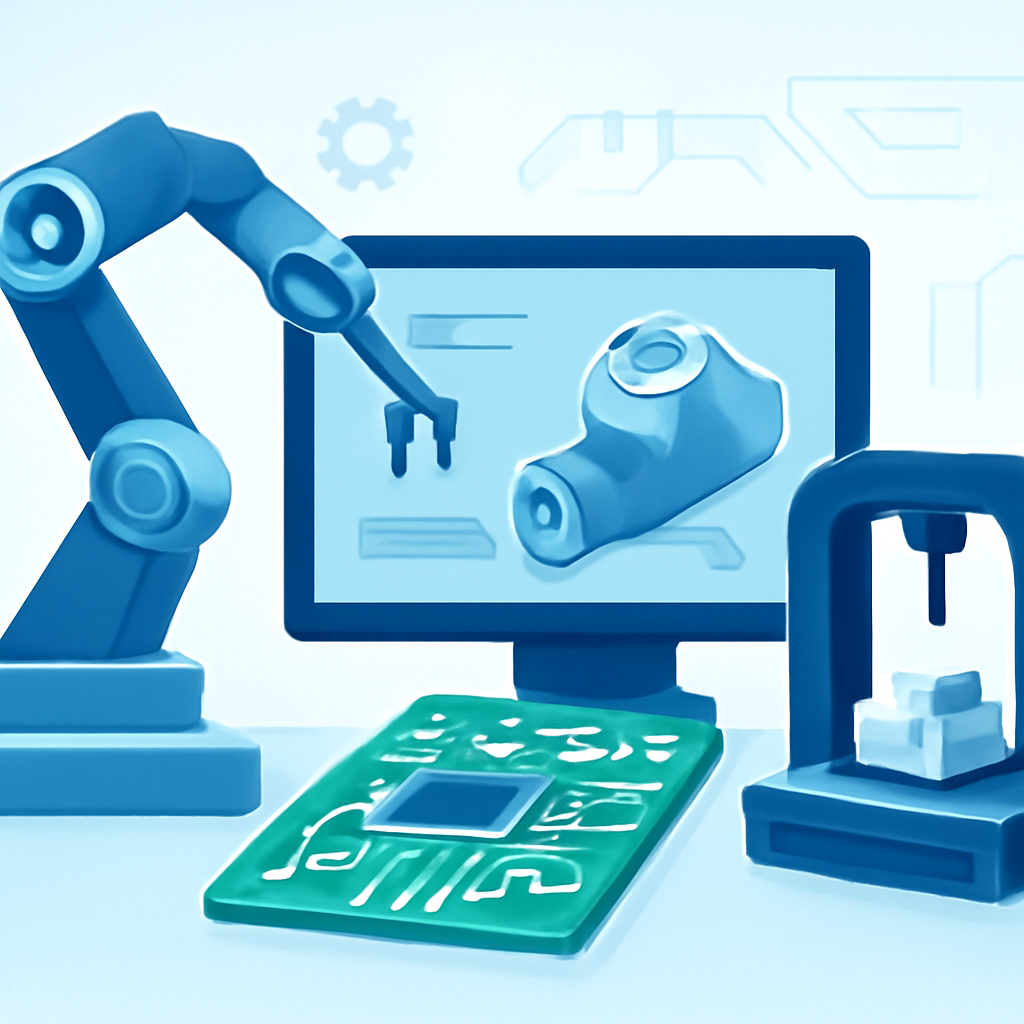
OpenAI is positioning AI for engineering as a force multiplier for teams that design, simulate and prepare physical products for manufacture. The company says its frontier models are already being used to reduce routine manual work in mechanical and electrical engineering tasks, enabling engineers to spend more time iterating on concepts while models assist with CAD revisions, PCB layouts, simulation setup and firmware generation.
According to OpenAI, its internal teams leverage ChatGPT, Codex and newer frontier models to support many activities that traditionally require specialized tools and deep domain expertise. Reported model-assisted workflows include revising computer-aided design (CAD) models, creating manufacturing drawings, running simulations, and reviewing systems for robotics and compute infrastructure. OpenAI frames these as early efforts to let models handle repetitive or time-consuming steps in end-to-end product development pipelines.
The company lists specific examples where models have been applied: defining functional requirements, shaping mechanical enclosures and internal support structures, selecting electrical components and arranging printed circuit board (PCB) placement, and producing firmware and integration code. OpenAI says these capabilities have been used on internal hardware efforts and experimental device builds, showing practical utility across a range of engineering tasks.
A notable multimodal experiment involved GPT-6 Astra, which OpenAI tested to assess whether a single model could produce a device design with minimal human edits. Astra reportedly provided an aesthetic direction, designed the external enclosure and internal supports, selected electrical parts and laid out PCB placement, and generated UI/UX and firmware components to integrate with Codex. Two team members completed the design work with Astra in under a week as a side project, and a contract manufacturer produced a small batch of prototypes within a month.
OpenAI is candid about the limitations observed: the prototypes required additional human review and further iteration before they could be considered manufacturing-ready. Astra did not consistently account for production constraints such as manufacturing tolerances and detailed assembly considerations. The company presents these shortfalls as concrete areas for improvement, helping to define technical priorities for future model development and evaluation.
To measure progress, OpenAI is developing benchmarks that combine coding aptitude with engineering domain knowledge. BenchCAD 2.0 evaluates whether models can reconstruct 3D parts and assemblies and correctly identify circuit-board connections. OpenAI reports that a newer internal model achieved an average score of 0.875 on this benchmark, compared with 0.594 for GPT‑6 Astra at its highest reasoning setting. OpenAI interprets these results as early evidence that models can accelerate iteration speed in professional engineering workflows, while emphasizing that design is only one phase of a broader product lifecycle.
Real-world applicability is being tested through a small set of industry collaborations that review model outputs for technical accuracy and manufacturability. Chip Ganassi Racing (CGR) is one partner; OpenAI and CGR’s R&D team are exploring workflows that convert 3D scans of legacy parts into editable CAD models and 2D manufacturing drawings, a capability useful when original design files are unavailable. CGR engineers evaluate where model assistance can reduce manual work and where further refinement is needed.
OpenAI also announced a research collaboration with Mazda, involving the company’s research and Forward Deployed Engineering teams and Mazda’s aerodynamics and crash-safety engineers. The work applies simulations of airflow and structural behavior to explore trade-offs among performance, styling and cost. OpenAI says it has obtained agreement for use from Mazda Motor Corporation and plans to share additional progress and results in coming months.
Usage within OpenAI’s hardware teams has grown markedly: measured in tokens, model usage rose 23-fold since February, the company reports. OpenAI is inviting engineers, design and simulation firms, and software vendors involved in manufacturing or production of complex physical products to collaborate. Interested parties can apply through OpenAI’s collaboration form to help identify high-value use cases, tooling needs and areas where models require improvement before broader, safe adoption.
OpenAI emphasizes that industry-reviewed deployments and iterative feedback are central to understanding which tasks models can reliably support today. The company presents its current work as a blend of promising automation and clear limitations: models can accelerate routine engineering workflows, but professional review and manufacturing-aware checks remain necessary. As OpenAI continues benchmark development and partner trials, the evolving collaboration between engineers and models will shape where AI for engineering can safely and effectively fit into real-world product development.
In conclusion, OpenAI’s recent efforts signal an ambitious push to integrate advanced models into physical-product engineering. The company’s experiments, benchmarks and industry partnerships offer a practical roadmap for where models can relieve manual burdens today and where further technical work is required to reach manufacturing-ready reliability.
Source: Read the original source
Leave a Reply