
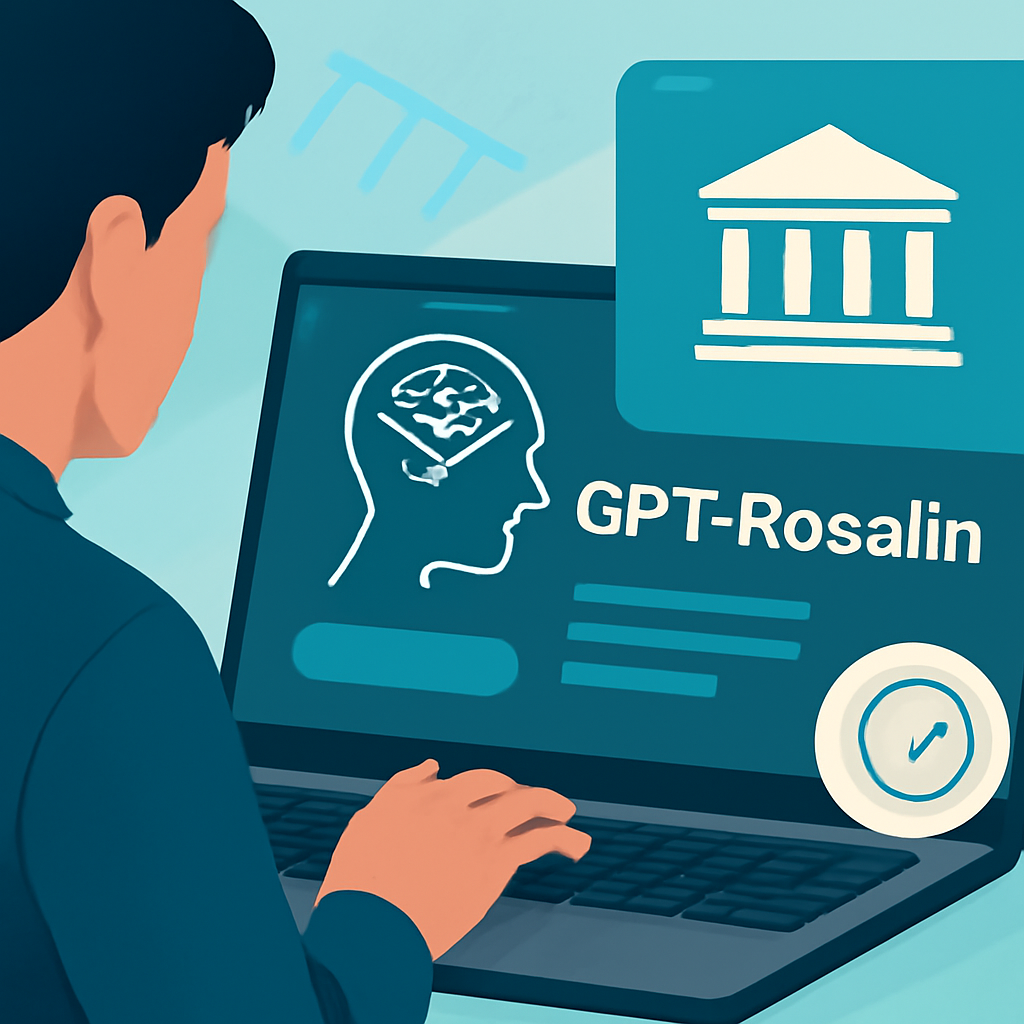
OpenAI today unveiled the Rosalind Academic Plan, a program designed to broaden academic access to GPT‑Rosalind and the Rosalind Workbench for qualifying U.S. university research labs. The plan offers approved labs up to 30 Business Standard seats at no cost per user for up to 12 months, along with access to commercially available frontier OpenAI models under specified usage limits. Access to GPT‑Rosalind itself is gated by a trusted-access approval process intended to balance research utility with safety oversight.
The Rosalind Workbench and GPT‑Rosalind are positioned as specialized tools for life sciences research. GPT‑Rosalind is described by OpenAI as a model tuned for deeper reasoning on complex biological problems, while the Rosalind Workbench supports the orchestration of specialized tools across domains such as medicinal chemistry, genomics, and wet‑lab assistance. OpenAI says distinguished academic labs are already exploring these capabilities in workflows that include protein design and research into neurodegeneration.
Eligibility and the application pathway are focused on U.S. university settings. Principal investigators and lab leads at institutions that do not have an OpenAI Enterprise agreement may apply on behalf of their labs through OpenAI’s trusted access process. Laboratories at universities that already maintain an Enterprise agreement must obtain access through their institution’s Enterprise channel. Once a lab is approved, the designated lab lead can activate free access for up to 30 named members and manage per‑member permissions. Notably, the Rosalind Academic Plan does not provide API access at this time.
OpenAI emphasizes several controls around data use and model training. Research data shared through the Rosalind Academic Plan is not used to train OpenAI’s models by default, and access to other commercially available frontier models is subject to plan‑specific usage limits. Because GPT‑Rosalind access requires trusted‑access approval, use of that model is also subject to ongoing monitoring and any enforcement policies that apply under the plan.
Responsible access procedures play a central role in OpenAI’s approach. Before activating lab access, the company conducts verification steps to confirm institutional legitimacy and the identity and authority of the principal investigator or lab lead. The review looks at the lead’s professional background, institutional appointment, and their authority to oversee lab access; it also assesses the lab’s affiliation, its research activities, and intended use. OpenAI requires labs to name an institutional safety contact and clarifies responsibilities for lab leaders to ensure appropriate oversight.
Safeguards extend beyond initial verification. OpenAI says it will continue monitoring registered activity and enforce policies where necessary. For high‑sensitivity research use cases, the company’s safety checks consider the approved research context, and OpenAI may follow up with researchers to clarify projects or confirm authorization. This layered process is intended to detect potential misuse while minimizing disruption to legitimate academic work.
OpenAI frames the Rosalind Academic Plan as an investment in the basic academic research that often underpins major downstream advances in medicine, biotechnology and agriculture. The company cited past scientific milestones—such as the Human Genome Project, CRISPR development, and foundational mRNA research—to illustrate how earlier academic discoveries enabled broader technology and therapeutic breakthroughs. By reducing the financial barrier to specialized AI tools, OpenAI says the plan aims to enable more researchers to combine domain expertise with model reasoning to address foundational questions in biology.
For principal investigators and lab leads interested in applying, OpenAI directs them to a help center guide that describes eligibility criteria, application requirements, and the trusted‑access process. Verified PIs and lab leads will be responsible for managing member permissions and ensuring that lab members use the tools in compliance with approved allowances. Additional details and the original announcement are available through OpenAI’s public materials.
The Rosalind Academic Plan represents a targeted effort to connect specialized life sciences AI tooling with academic labs while embedding procedural checks intended to prevent misuse. By coupling access to GPT‑Rosalind and the Rosalind Workbench with trusted access and monitoring, OpenAI aims to broaden research participation in areas such as medicinal chemistry and genomics while maintaining oversight of sensitive activity. Interested researchers at eligible U.S. universities can consult OpenAI’s documentation to learn how to apply and what responsibilities lab leaders will assume under the plan.
Source: Read the original source
Leave a Reply