
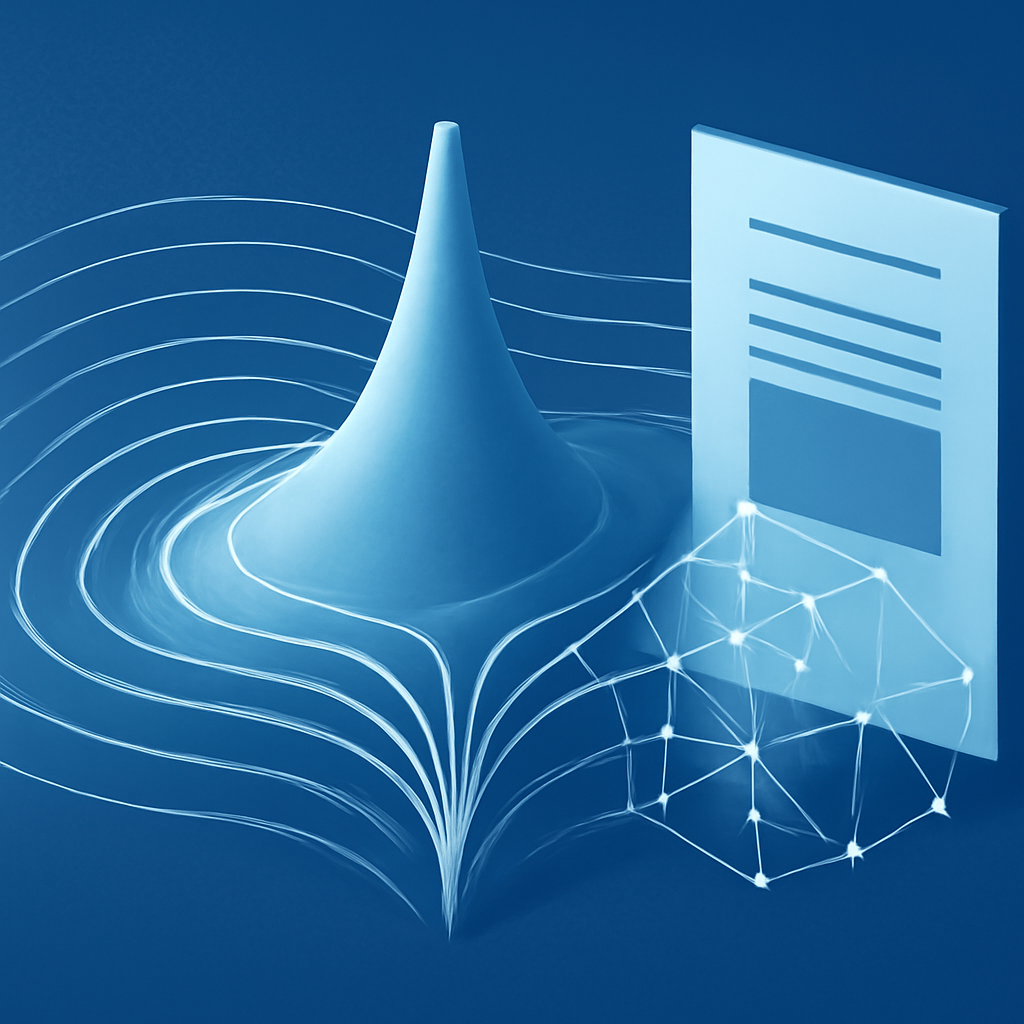
Navier–Stokes singularity has long been one of mathematics’ most persistent open questions; OpenAI today reported that an internal AI system produced both an analytical proof and a Lean formalization showing a smooth, three-dimensional incompressible fluid can develop a finite-time singularity. The company published a detailed writeup and the formal proof on its website and framed the work as a demonstration of its models’ research capabilities rather than a claim to any prize.
According to OpenAI, the result addresses the Clay Mathematics Institute’s Millennium Prize Problem variants labeled “C” and “D.” The problem asks whether smooth initial conditions for a three-dimensional incompressible fluid with constant density, governed by the Navier–Stokes equations, can evolve into a singularity in finite time despite the smoothing effect of viscosity. While Jean Leray established the existence of weak solutions in 1934, the question of whether smooth solutions can break down in finite time has remained unresolved for roughly nine decades.
OpenAI’s account describes an explicit construction in which a fluid initially at rest, acted on by a smooth external force, evolves so that velocity becomes unbounded in finite time while the total energy of the system remains finite. The reported construction takes the form of a vortex: a spinning region that spirals inward and stretches along its axis, shrinking locally and accelerating so that velocity magnitudes grow without bound even as the system’s energy stays bounded.
The company says the proof carefully tracks how the Navier–Stokes terms—acceleration, pressure gradients, momentum transfer and viscosity—can become large and yet cancel in a highly precise manner that preserves the smoothness of the applied force while permitting divergence of velocity. OpenAI released both a mathematical exposition of the argument and a machine-verified Lean formalization of the result.
OpenAI attributes the discovery to a multiagent system driven by a new internal model it describes as exceeding the capability of GPT‑6 Astra. Training for that internal model began on August 28, and formal evaluation began on September 1. For the Navier–Stokes effort, OpenAI reports that roughly 10,000 concurrent agents contributed to the group that produced the solution. These agents used tools including a cached internet reading environment and code execution to explore constructions and verify steps.
The company reports the agent group produced the Navier–Stokes resolution about 88 hours after the initial agent launch, on Saturday, September 5, with Lean formalization and verification requiring an additional 17 hours using GPT‑6 Astra. OpenAI also provided aggregate operational figures: across all Millennium-problem attempts its agents exchanged 4.9 million messages and generated roughly 300 billion output tokens; the Navier–Stokes effort alone accounted for about 2.7 million messages and roughly 130 billion output tokens.
OpenAI said it began the project after hearing rumors of parallel work. The company contacted mathematicians Levent Alpöge and Tristan Buckmaster when it believed they had a related result, and offered to coordinate a concurrent release. OpenAI reports that Alpöge and Buckmaster, using an internal Anthropic model, produced a resolution of a forced Euler problem; OpenAI acknowledges their priority on that forced Euler result and notes its own agents produced an unforced Euler resolution earlier in the effort. OpenAI also states it investigated and confirmed that Buckmaster’s Codex prompts in the months before the announcement could not have influenced OpenAI’s internal model or training data.
OpenAI emphasizes that the publication is intended as a report on model capability and a contribution to the mathematical record rather than an attempt to claim the Millennium Prize. The company says it will study the internal model and the multiagent process used to produce the result to guide further development, with particular attention to steerability and accountability. The full mathematical writeup and the Lean formalization are available from OpenAI at the company’s published link.
If confirmed and validated by the broader mathematical community, the result would represent a major development in both fluid mechanics and automated mathematical reasoning. OpenAI’s release makes its materials available so researchers can examine, reproduce and scrutinize the arguments and formal verification artifacts. The company’s emphasis on providing the writeup and Lean code makes independent verification possible and frames the announcement as a contribution to open scholarly review.
OpenAI’s release marks a prominent example of AI systems being used to pursue deep theoretical problems, and it highlights both the potential and the need for careful human-led validation when AI systems generate claims in foundational areas of mathematics.
Source: Read the original source
Leave a Reply