
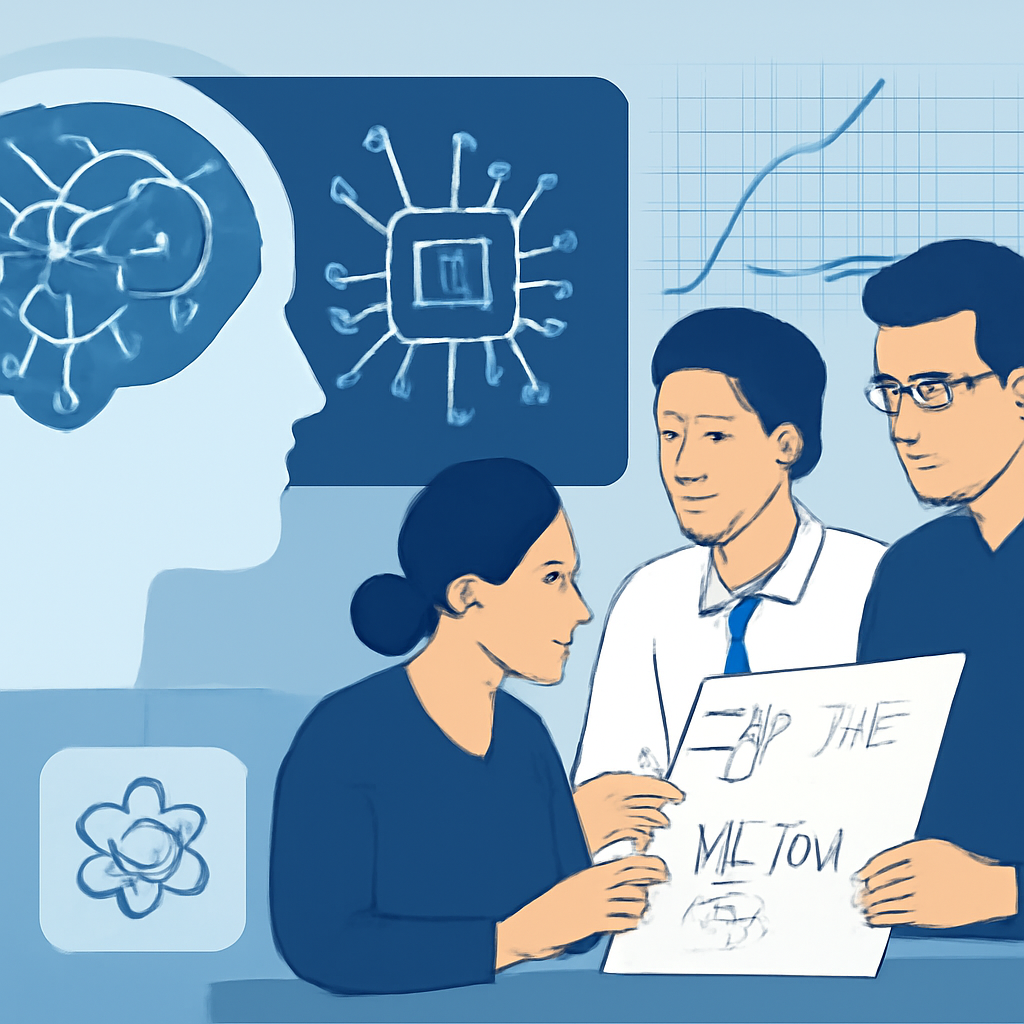
OpenAI has announced coordinated collaborations with academic communities to verify and contextualize a set of AI-generated proofs produced by its models across mathematics, complexity theory and quantum field theory. The company said these AI-generated proofs include a claimed resolution of a harmonic analysis conjecture with broader implications, a reported disproof of a major complexity assumption, and existence proofs for interacting quantum field theories — and that it is working with scholars to move these outputs toward vetted scientific understanding.
OpenAI described a release approach centered on formalization and academic stewardship. For the mathematical and computer-science results the company published both the models’ natural-language writeups and their Lean formalizations in a public GitHub repository; for the physics work it has transferred materials to a steward group and deferred broader release while that group prepares its own writeup. OpenAI said it will support and fund academic-led efforts, including workshops and a conference to examine the claims, and has committed to transparency about partnerships, a pledge not to seek academic credit, recognition for groups that contribute writeups, and independence for volunteer participants.
In mathematics, OpenAI reported that its models produced a proof of the local smoothing conjecture for the Euclidean wave equation in all spatial dimensions. OpenAI explained that this conjecture, posed by Sogge in 1991, concerns how concentrated waves can become over time and that a proof of local smoothing implies both the Kakeya conjecture and Stein’s restriction conjecture; the company therefore stated that the models’ proof resolves those conjectures in all dimensions. According to OpenAI, the natural-language proof was generated on October 18, 2026 and was formalized in Lean on October 19, 2026. Following advice from external experts, OpenAI made the natural-language writeup and the Lean formalization publicly available in its GitHub repository so independent researchers can organize verification and extension efforts.
In computer science, OpenAI reported that its system produced a refutation of the Exponential Time Hypothesis (ETH), a long-standing conjecture about the computational complexity of Boolean satisfiability. The company said the model’s natural-language refutation was produced on October 16, 2026 and formalized in Lean on October 17, 2026. Because the ETH underpins many conditional hardness results, OpenAI noted that a confirmed refutation would reopen questions about algorithmic speedups and require extensive further research to assess both practical and theoretical consequences. To shepherd community verification, OpenAI agreed to work with a group led by Russell Impagliazzo, Ramamohan Paturi and Ryan Williams. That group requested public access to all raw data to enable independent checks; OpenAI has released the natural-language writeup and Lean formalization for the ETH result and committed to funding a conference to examine the claim and its implications.
In theoretical physics, OpenAI reported that its models produced natural-language proofs establishing the mathematical existence of certain interacting quantum field theories in four dimensions, including pure Yang–Mills theory, Quantum Chromodynamics (QCD), and a unified completion of the Standard Model’s gauge fields and fermions. OpenAI said the models produced a natural-language proof for Yang–Mills existence on September 9, 2026 and for QCD on September 18, 2026, and that the Lean formalization of the Yang–Mills existence proof was completed on October 16, 2026. Given the scale and complexity of this work, OpenAI transferred artifacts to a stewardship group led by David Gross and including Michael Douglas, Arthur Jaffe, Igor Klebanov and Nikita Nekrasov. That group has asked OpenAI to hold off publishing the AI artifacts while they develop their own explanatory writeup; communications about the effort were directed to YANGMILLS4D@gmail.com.
OpenAI emphasized that its approach combines formal verification with Lean and academic stewardship as mechanisms to move AI outputs toward established scientific knowledge. The company acknowledged tradeoffs in selecting initial shepherds: experts can accelerate unpacking and contextualization, but early selection shapes participation and access. OpenAI invited feedback on how to broaden involvement and said these collaborations complement a recent funding commitment to the Simons Foundation, which will support workshops, conferences and programs to help researchers understand and build on AI-produced results.
Why these developments matter — if verified and adopted — is clear from OpenAI’s account: they would touch foundational questions across disciplines by resolving conjectures in harmonic analysis, overturning a major complexity assumption used to infer hardness results, and providing rigorous existence proofs in quantum field theory. OpenAI framed formalization, public release of artifacts for two results, and partnerships with academic experts as steps toward independent verification and scholarly explanation. The company reiterated its intent to fund and support academic-led efforts to independently examine, explain and extend these discoveries and welcomed community input on disclosure and engagement practices.
The path from AI output to accepted scientific result depends on independent verification, exposition and community scrutiny. OpenAI has made some artifacts public, convened steward groups for others, and committed resources to enable deeper examination. The coming months and years will test whether these AI-generated proofs can be robustly validated, explained, and integrated into the body of mathematical, computational and physical knowledge.
Source: Read the original source
Leave a Reply