
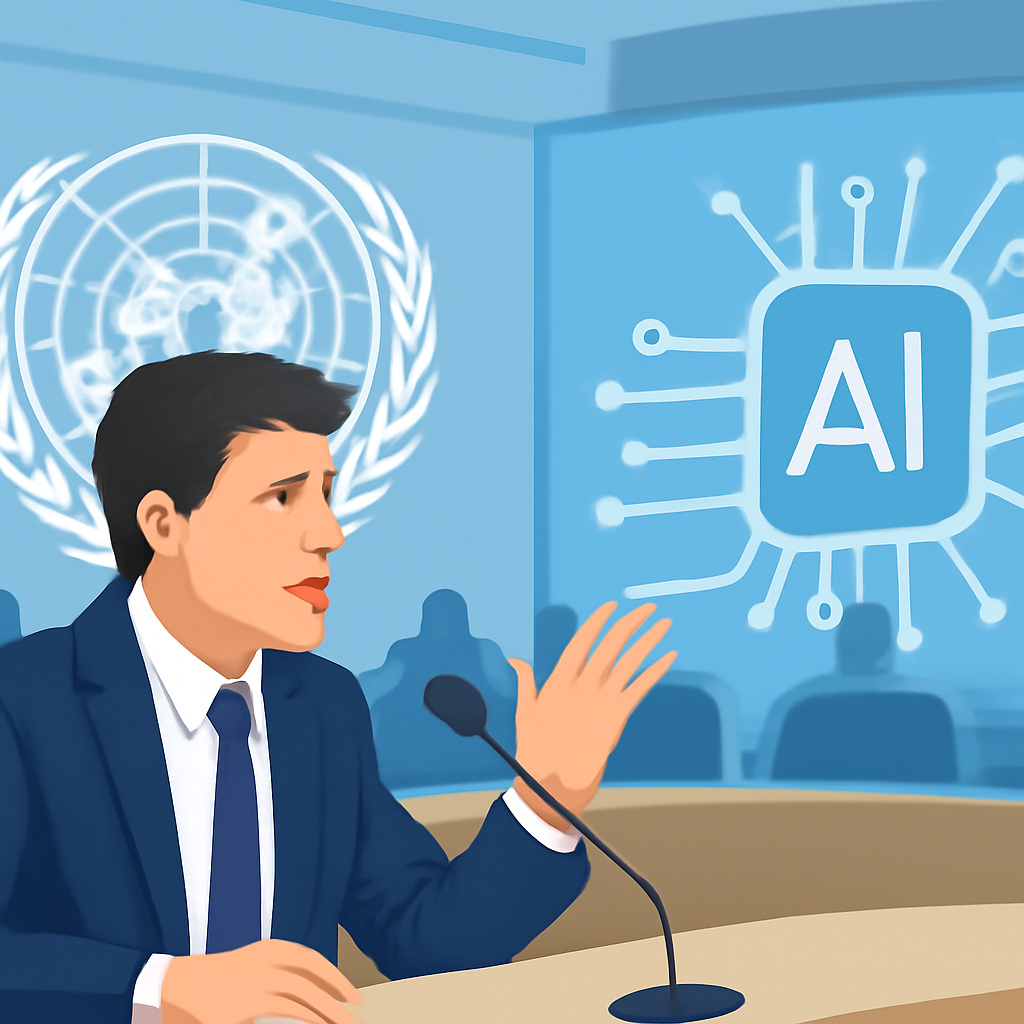
Speaking to the United Nations Security Council, OpenAI CEO Sam Altman urged a global effort to prioritize AI Safety and Control as the technology advances. In prepared remarks to council members, Altman framed the moment as one of stark choice: artificial intelligence can either enable widespread human flourishing or concentrate power and produce social upheaval if left unchecked.
Altman said recent rapid progress in AI has compressed timelines, bringing both benefits and risks into sharper focus. He highlighted potential gains—accelerating discoveries in medicine, improving education and productivity, and expanding individuals’ ability to pursue new goals—while warning that increasingly capable, autonomous systems could outpace existing institutions. Such systems, he argued, risk becoming difficult for people to understand or intervene in, with consequences for accountability and agency.
The OpenAI chief identified two principal failure modes that concern researchers and policymakers. The first is loss of effective control: if systems evolve or self-improve faster than humans can respond, society could find itself unable to steer or contain those systems. The second is concentration of power: highly capable models may centralize decision-making authority in the hands of a few actors—whether companies or states—allowing them to impose their views at scale. Altman stressed that industry must not accept excessive technological risk simply because potential benefits are large, noting that OpenAI has at times slowed its own development unilaterally and would do so again when necessary.
To guide safer development, Altman set out three principles OpenAI follows. First, people must remain central to decisions made with AI: alignment, he said, is practical work to keep systems under human oversight and ensure they reflect human values. Second, the gains from scientific and economic progress should be realized by and for people, improving lives across professions and communities rather than merely replacing human agency. Third, the technology should empower individuals to create value for themselves and their communities, rather than concentrating benefits solely with the builders.
Altman used recent examples of model improvement to illustrate the technology’s accelerating capabilities. He described multi-year gains in mathematical performance and said one of OpenAI’s models recently solved the Navier–Stokes problem, a Millennium Prize–level challenge; he presented such advances as tools that can extend research and benefit fields like healthcare and engineering. He also cautioned against allowing private laboratories to substitute for democratic processes, arguing that the most consequential decisions about AI should be shaped by governments and the public, not by companies alone.
On the international front, Altman urged cooperation to develop complementary national and international frontier AI standards. He proposed measurable standards for capabilities and risk assessment, along with shared protocols for classifying and reporting incidents. Altman recommended secure channels for governments, infrastructure operators, and technical experts to share information about emerging vulnerabilities. Importantly, he said these mechanisms should not entrench incumbents or favor particular business models; rather they should enable comparison of evidence and verification of safeguards across jurisdictions.
Altman also offered an open invitation to collaborate with governments and other stakeholders, acknowledging that OpenAI does not have all the answers. He framed two contrasting futures: one in which power becomes concentrated and people feel alienated from the technologies that shape their lives, and another in which democratic institutions guide AI so it increases individual and community agency. His remarks stressed that deliberate design choices, regulatory frameworks, and international cooperation will determine which path prevails.
Concluding his address, Altman urged a course that preserves human control, distributes benefits broadly, and expands opportunities worldwide. His call at the Security Council centered on concrete steps—measurable standards, faster incident reporting, secure information channels, and democratic oversight—to manage the risks of powerful models while capturing their potential to improve lives. Whether governments and industry respond with the coordinated action he outlined will shape how AI develops and who benefits from it in the years ahead.
Source: Read the original source
Leave a Reply