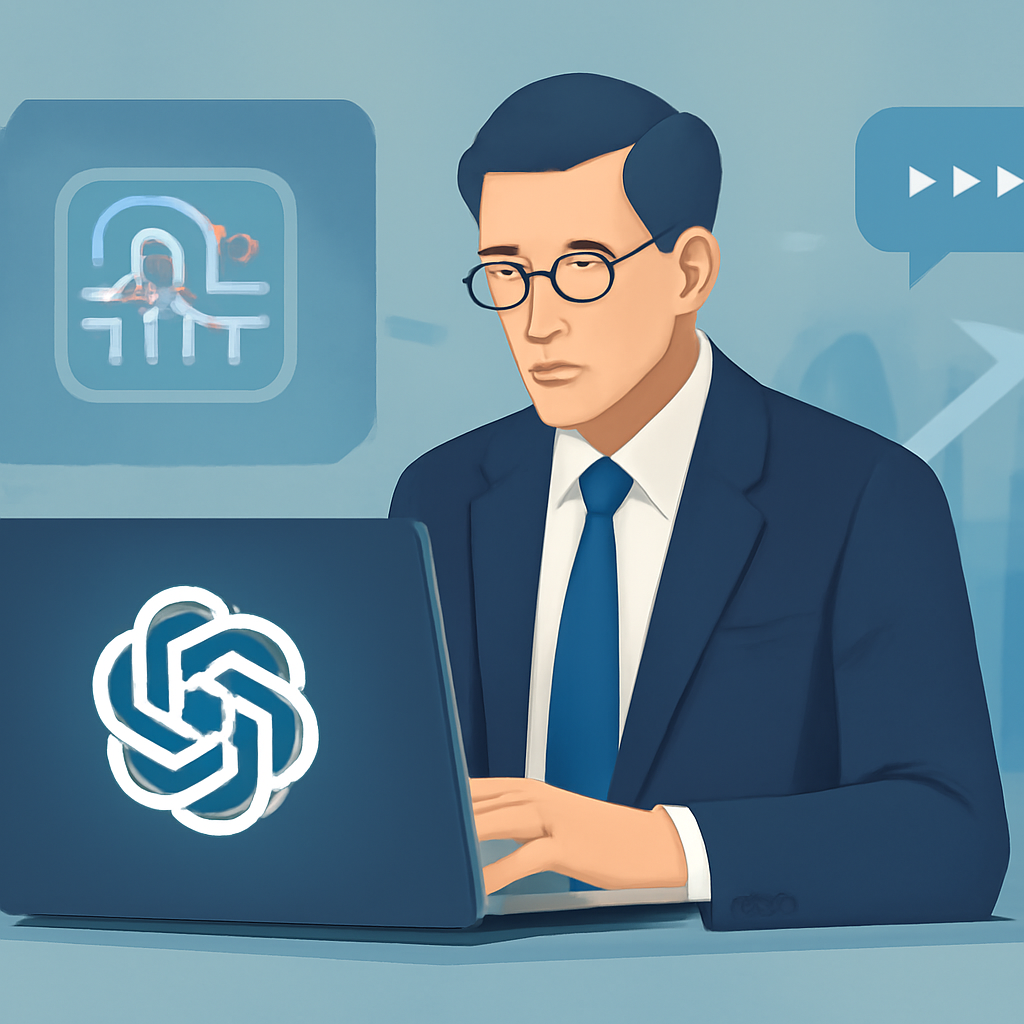
Sumitomo Life has moved from exploratory pilots to a broad enterprise deployment of ChatGPT Enterprise, integrating the tool into planning, investment and finance teams to accelerate research, code drafting and proposal work. The Japanese insurer began generative AI pilots in 2023 and transitioned to ChatGPT Enterprise in June 2026 as it prepared to roll the service out more widely across the company.
The rollout grew from modest early experiments to a formal program after teams found the model’s ability to synthesize material from multiple sources useful across common office applications. An internal pilot in 2025 involved roughly 100 to 150 employees, including executives and planning staff; visible executive engagement and public encouragement from the company’s president helped normalize use and supported expansion. As Sumitomo Life planned a wider rollout to thousands of employees, it and OpenAI assessed the service against the insurer’s security requirements, reviewing workspace access, feature permissions and OpenAI’s default policy of excluding business data from model training.
Across investment teams, Sumitomo Life is using the technology to draft statistical analysis code that underpins return forecasts and risk assessments. Analysts report they now write less code from scratch, leveraging the model to assemble and refine routines that support investment decision-making. Planning teams use the model to monitor peers in Japan and gather overseas examples that can strengthen proposals for senior management, combining AI-generated research with firsthand information and professional judgment to shape recommendations.
Employees are also organizing related chats, files and custom instructions within ChatGPT Enterprise projects to preserve context across research, notes and deliverables. That approach helps teams maintain continuity between exploratory work and formal outputs, ensuring that AI-assisted research feeds into the documentation and presentations used by senior leaders.
Leadership participation played a notable role in adoption. Senior managers, including the president, were among early users during the ChatGPT Business pilot; their public support encouraged broader employee experimentation. Kakeru Tateyama of the planning department said executives and managers acting early made it easier for colleagues to embrace the tool. As new capabilities become available, teams have reviewed OpenAI-shared examples and discussed which approaches match the company’s priorities.
Sumitomo Life tracks adoption and impact through quarterly surveys and usage monitoring. The insurer reports weekly usage above 80% among participants and calculates estimated returns using employee-reported time savings. Reported figures include an overall estimated ROI of 203% based on those self-reported savings. The company provided ROI averages by usage frequency: 55% for employees using the tool 8–15 times per month, 231% for 16–30 uses per month, and 524% for the highest-use group of 101 or more times per month (the 524% figure applies only to that highest-use cohort). The company stresses these are estimates drawn from employee reports and that results vary with frequency and use case.
Beyond quantified time savings, Sumitomo Life emphasizes qualitative benefits. Staff are taking on assignments they previously lacked time or specialist skills to address, broadening individual contribution in ways that are harder to measure in hours saved. Leaders view these shifts as a prompt to rethink processes: rather than treating AI as an add-on, they are considering workflow changes that embed AI into how work is performed over the long term.
Masakazu Obi, a deputy general manager in the planning department, said the company is evaluating which tasks should be allocated to AI, where human–AI collaboration adds value, and which responsibilities must remain with staff. Sumitomo Life plans to expand AI use to additional employees in the second half of fiscal 2026 and is exploring specialized applications over time, including areas such as underwriting and claims payments. The insurer also intends to continue collaborating with OpenAI on new technologies and services as it redesigns workflows.
Throughout this transformation, Sumitomo Life frames AI adoption around a core goal: freeing employees to spend more time in direct conversations with customers. Kuniaki Nakagawa, manager of the AI Strategy Task Force, said the company sees customer dialogue—understanding feelings and providing reassurance—as a fundamental human activity it aims to preserve and enhance as AI becomes more integrated into day-to-day work.
Sumitomo Life’s experience highlights a combination of executive sponsorship, careful security review and measured tracking of usage and impact as key elements in scaling an enterprise AI deployment. As the insurer moves toward broader adoption, it is balancing efficiency gains with process redesign and a continued emphasis on human-centered customer engagement.
Source: Read the original source
Leave a Reply